


The Triumph of Love
The Triumph of Love
Homily for the 2nd Lenten Vespers
at the Archdiocesan Chapel of the Transfiguration
Sunday 1st of March 2026
Your Eminence,
Your Grace,
Esteemed clergy,
Brothers and sisters in Christ,
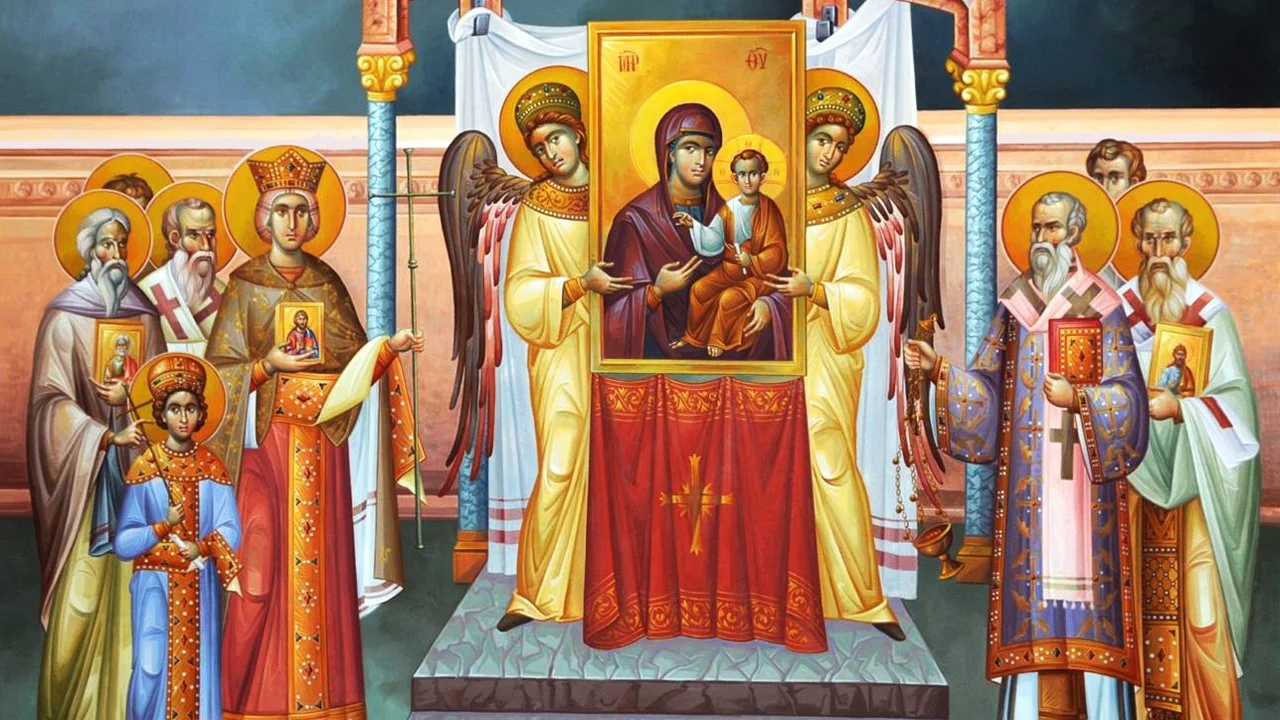
The Church celebrated today the Restoration of the Holy Icons, following the Synod of Constantinople held on the First Sunday of Lent in the year 843 under the auspices of the young Emperor Michael III, his mother Empress Theodora and Patriarch Methodios of Constantinople. The Synod concluded with a triumphal procession of the sacred images from the Church of our Lady of Vlachernon to the Great Church of Christ, the Cathedral of Divine Wisdom, and marked the end of the Iconoclast period.
However, we do not call this day the Sunday of Iconography but rather the Sunday of Orthodoxy.
Iconoclasm did not just represent an opposition to the use of representational art in Christian worship, but a faulty understanding of Christ, his incarnation, and its consequences for the world. Conversely, the sacred icons act as a safeguard and a tangible expression of the Orthodox faith in all its aspects.
When Moses ascended Mount Horeb and received the Second Commandment forbidding the making and worship of any “graven image or any likeness of any thing that is in heaven above, or that is in the earth beneath, or that is in the water under the earth”,[1] the same prophet explains that this commandment had been given because “ye saw no similitude on the day that the LORD spoke to you at Horeb out of the midst of the fire”.[2] In other words, the invisible God cannot and therefore must not be depicted, since such a depiction would by definition be a falsehood.
Far from disregarding the Second Commandment by its veneration of icons, the Church faithfully upholds its underlying principle by attesting to the fact that, in the context of the Incarnation, the same Word of God that spoke to Moses takes to himself a human nature, and thus becomes both visible and depictable. The Father and the Holy Spirit are depicted only in their visible theophanies – e.g., the dove, the cloud, the tongues of fire – but are never iconographic subjects as such, since they remain invisible and therefore undepictable. Rather, it is the Son alone who, according to the Anaphora of St Basil that we prayed this morning, is “the image of [the Father’s] goodness, the seal of equal type, in Himself showing forth [the Father]”, “the Express Image of [the Father’s] Person”, who “released us from the delusions of idols” by “becoming conformed to the fashion of our lowliness, that He might make us conformable to the image of His glory”.[3]
The iconography of the Orthodox Church, then, acts as a safeguard and expression both of the unity and equality of the divine Persons of the Holy Trinity, against those who like Arius sought to divide them, and of their distinction, against those who like Sabellius sought to confuse them.
The icons are a safeguard and expression of the reality of the Incarnation, that it was neither illusory nor temporary. That God truly became man, and became so forever.
Our icons of Christ depict a man, but this man can be identified as ὁ Ὥν, the Existing, the I AM THAT I AM, who spoke to Moses in the burning bush at Sinai,[4] because icons are not images of natures (abstract categories of being), but of persons. While Christ is only depictable by virtue of his humanity, an icon of Christ is nonetheless a depiction of the one hypostasis and person of the Word of God Incarnate, and identifies this one person of the God the Word, “by whom all things were made” as the one who for us men and for our salvation came down from heaven, was born of the Virgin Mary, was crucified for us under Pontius Pilate, suffered, was buried, rose again on the third day, ascended, and who is coming again in glory.
Icons also make tangible for us the effects of the Incarnation, as St John of Damascus so beautifully puts it: “I do not worship matter, I worship the God of matter, who became matter for my sake and deigned to inhabit matter, who worked out my salvation through matter”.[5]
In other words, the icon reminds us of our call to sanctification through our mystical incorporation into the One, Holy Catholic Apostolic Church through the “one baptism for forgiveness of sins”, a process that will culminate in our “resurrection from the dead and the life of the age to come”, to which the icons point as ‘windows into heaven’.
The icons are our constant reminders of the saints, who in the New Testament take up their place on the walls of the temple alongside the angels of the Old,[6] having “fought a good fight, finished their course, and kept the faith”.[7]
The icons are also what allow the Lord and his saints visibly and tangibly to stand in our midst at the synaxis, the gathering of the faithful, where the Church militant and the Church triumphant gather together before the throne of the conquering Lamb.[8]
The icons, as tangible expressions of the unity that defines our faith — the unity of God and man, of heaven and earth, material and immaterial — are thus a summary of our shared faith, worship, and hope as Orthodox Christians, and of our unity in that faith, as so beautifully expressed yesterday evening, when hierarchs, clergy and faithful from the various Orthodox jurisdictions in the United Kingdom joined our Archbishop in the joint celebration of Vespers at the Cathedral of Divine Wisdom here in London.
To these dogmatic expressions, our Lord adds his own theology of the icon. When asked whether “it is lawful to give tribute unto Caesar, or not?”, he asks to be shown the tribute money, and asks, “Whose is this image and superscription?”. When he is told that it is “Caesar’s”, he utters the well-known phrase, “Render therefore unto Caesar the things which are Caesar’s; and unto God the things that are God’s”.[9]
These words of the Lord were, of course, not spoken so that we may contemplate our relationship with the state, but so that we may consider whose image we ourselves bear, and to whom we should render our life and our being, lest we conform ourselves to the likeness of another. And as well as calling us to consider ourselves as image-bearers of God, these words also call us to recognise the image of God in others.
Hearing as we do, especially as of yesterday, “of wars and rumours of wars”,[10] one needn’t wonder how different the world would be if we all genuinely saw in one another the image of our Creator and Saviour.
And we live in a world afflicted not only by external conflicts and social injustices, but also of great internal unrest, where things like anxiety, depression, despair and lack of purpose have become something of an epidemic. Again, how different things would be if we truly saw in ourselves the image of God.
Such an awareness makes pride impossible, because it entails an acknowledgement that all things come from, belong to, and are to be rendered unto God.
Such an awareness also protects us from unhealthy expressions of self-abasement. For while a self-hating person will attack his own self and drive himself to the depths of despair by dwelling on his own inadequacies, a spiritual person attacks only that which obscures the image of God within. Such self-reproach, even when difficult and painful, always produces the fruits of hope and joy. As St Silouan says, such a person can descend even into Hades without falling into despair. And, as the fathers of the Monastery so often remind us, such a descent is an unavoidable part of Christian life because it is the path of Christ, and thus the path that we as Christians are called to follow. A recognition of our own iconic relationship to God is thus necessary, because it is what allows us to take up our Cross, as Christ invites us to do,[11] without being destroyed by it.
If we could summarise the purpose of the period of Great Lenten that we now find ourselves in, it would be this: to rediscover the image of God within ourselves and within our neighbour, fulfilling the two great commandments on which hang all the Law and the Prophets: to love the Lord our God with all our heart, mind, soul and strength, and to love our neighbour as ourselves.
During Lent, the canons of the Church invite us to reduce and simplify our intake of food so that we can share what we save with those in need.[12] In this way, my hunger allows another to eat, my constraint frees another from his, reducing the time I devote to worldly comfort allows me to comfort another plagued by loneliness. Whether we speak of food, money or time, fasting becomes a practical way for me to learn how to love my neighbour as myself, in that my own needs become the occasion for another’s satisfaction.
That this Triumph of Orthodoxy is celebrated on the first Sunday of Lent is due not only to the historical timing of the Synod of 843, but to remind us that the faith we proclaim as Orthodox Christians cannot be abstracted and separated from a lived orthopraxy, which in turn must not become an inward-looking observance of rules, but an outward-looking expression of and exercise in Christian love. For what is the Triumph of Orthodoxy if not the Triumph of love?
In the Divine Liturgy, the deacon calls us to “love one another that with one mind we may confess” the faith contained in the Creed, because the Creed is a testament to God’s love, and without love it cannot be comprehended.
“God is love,” as St John the Evangelist tells us,[13] because the one God exists eternally as a communion of love between the three divine persons of Father, Son and Holy Spirit. The Trinity creates us out of love in order to be partakers in and reciprocators of that love. It was in order to preserve our ability to love that God allowed us to fall, and it is because “God so loved the world that he gave His Only-begotten Son”[14] in order to restore us from that fall. Out of love, the Son of God “emptied himself, taking on the form of a servant”.[15] Out of love he was born of the Virgin Mary, and when he, as the ultimate expression of his love, hangs on the Cross for our salvation, he turns to us and gives to us that same woman as the loving Mother and intercessor of the Church. In love, he descends into Hades, raises us out of corruption and glorifies our nature by his ascension. In love he sends us his Holy Spirit, the foremost fruit of which is love,[16] and out of love he daily gives himself to us as life-giving food and drink in the Eucharist, until the time when he shall come again and judge us by one criterion: whether we have loved; and specifically, whether we have loved him in the person of the poor, the hungry, the sick and the imprisoned who bear his image.[17]
The Lord tells us: “A new commandment I give unto you, That ye love one another; as I have loved you, that ye also love one another.”[18] The Triumph of Orthodoxy is a reminder of the former, Great Lent a call to the latter.
Let us take care then, that as we rightly bow down before the icons of the Lord painted on wood, we do not despise the icons of flesh bearing the same image. For as St John Chrysostom famously said: “If you do not find Christ in the beggar at the church door, neither will you find him in the chalice.”[19]
Fr Kristian Akselberg
[1] Exodus 20:4
[2] Deuteronomy 4:16
[3] Isabel Hapgood (trans.), Service Book of the Holy Orthodox-Catholic Apostolic Church (New York: Syrian Antiochian Orthodox Archdiocese, 1965), 101–3
[4] Exodus 3:14
[5] On the Divine Images 1:16
[6] Cf. 3 Kingdoms 6:29
[7] 2 Timothy 4:7
[8] Cf. Revelation 7
[9] Matthew 22
[10] Ibid. 24:6
[11] Ibid. 16:24
[12] Apostolic Constitutions 5:20
[13] 1 John 4
[14] John 3:16
[15] Philippians 2:7
[16] Cf. Galatians 5:22
[17] Cf. Matthew 25:31–46
[18] John 13:34
[19] This is a common paraphrase of Homily 50:3–4.