


Speech for National Day of Greece 2026
SPEECH DELIVERED BY THE PRESIDENT
OF SAINT ANDREW’S CATHEDRAL CHURCH
MANOLIS STAVRIANAKIS
FOR THE CELEBRATION OF
THE NATIONAL DAY OF GREECE
March 2026
Dear friends,
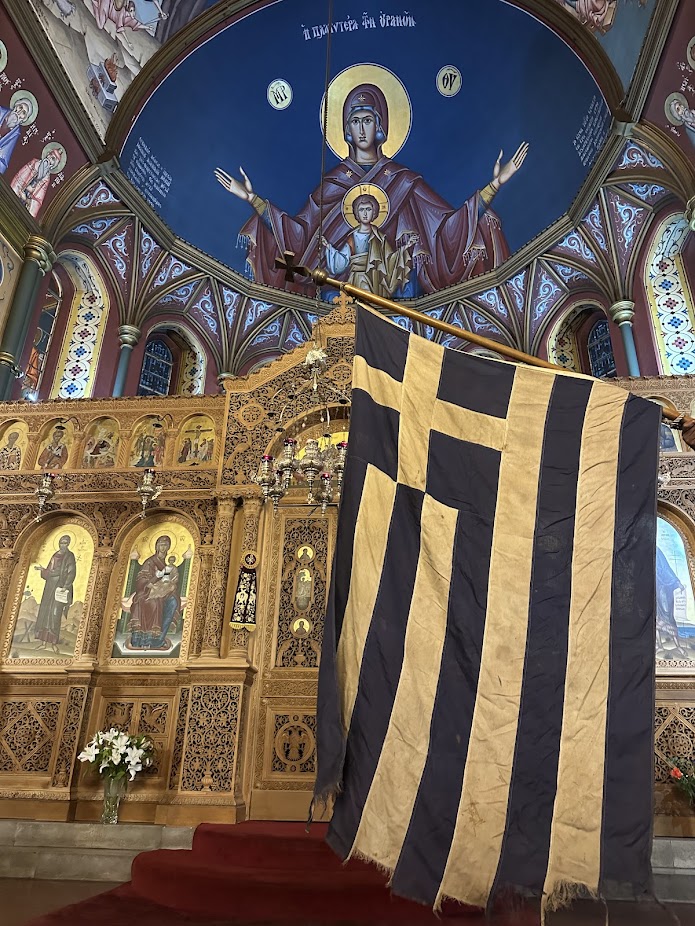
There is an unbreakable bond of the Greeks with the sea throughout history and this bond is manifested in the form of the Greek flag. A live example is the flag next to me which was flown by a Greek ship called “CAPETAN CARRAS”, a combination carrier of 84,000 tonnes for transportation of oil or dry cargoes. During her lifetime in the 1970’s and 80’s sha called on all five continents and sailed through all major oceans and other seas of the planet, including, by the way, the Strait of Hormuz and the Persian Gulf , where she took a full load of oil more than 12 times at the port of Bandar Abbas.
Today we are celebrating the Greek National Day , the anniversary of the start of the Greek War of Independence of 1821. Because of the deep rooted bond of our nation with the sea , we dedicate today’s celebration to the Naval Struggle of the Greeks against the Ottoman rulers .
The naval history of the Greek War of Independence (1821-1829) was critical to the final victory and was driven by the transformation of merchant ships from the islands of Hydra, Spetses and Psara into fighting ships that challenged the Ottoman navy. These armed ships and their crews , who had gained valuable experience during the Napoleonic Wars and by fighting against the Barbary corsairs from Algiers, Tunis and Tripoli , formed the nucleus of the Greek fleet. Combining extraordinary agility coupled with the superior seamanship and naval skill of the Greek seamen, the Greek ships achieved a number of astonishing victories against the Ottoman navy which was much superior in numbers, tonnage and guns onboard.
Under the leadership of great naval leaders, like the prominent admiral Andreas Miaoulis and the legendary fire-ship captain Konstantinos Kanaris as well as thanks to the enthusiasm, devotion and sacrifice of the unique woman commander Laskarina Bouboulina, the combined Greek fleet performed unbelievable deeds of heroism and showed exceptional naval ingenuity. Also, other merchant captains from Hydra, Spetses and Psara converted their fast and agile 2-masted brigs into combat vessels, thus providing the backbone of the resistance. The combined Greek fleet during most of the naval operations comprised 80 ships, mainly brigs, coupled with a small number of 3-masted corvettes, with an average displacement of 200-400 tonnes , equipped with 12-18 canons each. On the other side the Ottoman navy consisted of dedicated purpose built warships, which included large ships of the line and frigates. The ships of the line had a displacement of 3,000 tonnes and carried 84 guns, while the frigates displaced 1,200 tonnes and carried up to 44 guns.
It is clear that Greek ships could not stand a chance fighting in a traditional way the larger and better equipped Ottoman ships, their guns being too light to inflict substantial damage to Ottoman ships of line and frigates. But, the Greeks fielded a secret “terror” weapon , which they used to devastating effect : FIRE-SHIPS. Fire-ships were ordinary small vessels expertly converted, packed with explosives throughout, which were stuck to the sides of the enemy ships and set on fire. During the war, Greek fireships undertook a total of 59 attacks, of which 38 were successful, leading to the complete destruction or serious damage to the enemy ships. The most famous achievement of a fire-ship was the complete burning of the Ottoman flagship off the island of Chios on 7 th June 1822 by Konstantinos Kanaris , at which the Admiral of the Turkish fleet Kara Ali also lost his life This action, in retaliation of the Chios massacre and slaughter of many thousands of people by the Ottoman Turks on Easter day of 1822 , elevated Kanaris to the status of national hero. Moreover, the nominal strength of the Ottoman fleet vis-à-vis the Greek ships tells only one part of the story because the Ottoman navy suffered in having inadequately trained crews with poor seamanship and insufficient knowledge of the bays and seas where the naval battles took place.
The Greek navy’s main task was to support land operations and blockade Turkish garrisons in cities like Nafplion and Patras that were under siege by Greek land
forces , forcing these garrisons to surrender. Thus, for example, the Greek ships, under the leadership of Andreas Miaoulis, repulsed the Ottoman fleet’s attempt to relieve the Turkish garrison of Nafplion during the Battle of Spetses at the Strait between the island of Spetses and the Peloponnesian coast of Hermione on 8th September 1822.
A second main task of the Greek fleet during the entire war was to protect the many islands that had revolted, against Ottoman landings for reprisals A good example was the safeguard of the island of Samos, following the war’s biggest naval battle that the Greeks have fought, the battle of Gerontas , at the Strait between cape Gerontas on the coast of Asia Minor and the islands of Leros and Kalymnos on 29 th August 1824 , which was one of the most decisive naval engagements of the Greek War of Independence. However, it hadn’t been possible to prevent landings by the Ottoman fleet on the islands of Chios , Kassos and Psara, which led to the deaths and slavery of thousands of Greek people. These Ottoman atrocities led to an outcry of sentiment among European populations and increasing public opinion pressure on their governments to intervene on behalf of the Greeks. Thus, diplomatic considerations by the governments of Great Britain, France and Russia concluded that it might be to their advantage to help the Greek Struggle for Independence. This resulted in the decisive intervention of the navies of these Great Powers of that time and the ensuing Naval Battle of Navarino on 8 th October 1827
(O.S.) – 20 TH October (N.S.) . . During this famous battle the combined Allied fleet of Great Britain, France and Russia, led by admirals Sir Edward Codrington, Henri de Rigny and Lodewijk van Heiden respectively, with commander in chiel the fervent philhellene Edward Codrington, annihilated the combined Ottoman and Egyptian fleets, of which 60 ships, out of a total of 89, were completely destroyed and ultimately sunk, and 6,000 Turkish and Egyptian crew lost thein lives. The outstanding achievement of the Battle of Navarino safeguarded the successful outcome of the Greek War of Independence and laid the foundations for the formation of the Greek State of the modern era.
The Naval Struggle of the Greeks during this War and the successes of the Greek navy demonstrated that superior seamanship and innovative tactics overcome
numerical superiority. On the whole, the Greek navy of converted merchant ships successfully withstood the assault of five navies, those of Turkey, Egypt, Algiers, Tunis and Tripoli, which included numerous purpose built warships. It was a sea David’s victory against sea Goliaths and has proven the deep and unbreakable bond of the Greeks with the sea.
Thank you very much for your attention