


Sermon on Lazarus Saturday – 3/4/26
Sermon on the Resurrection of Lazarus
Saturday 3 April 2026
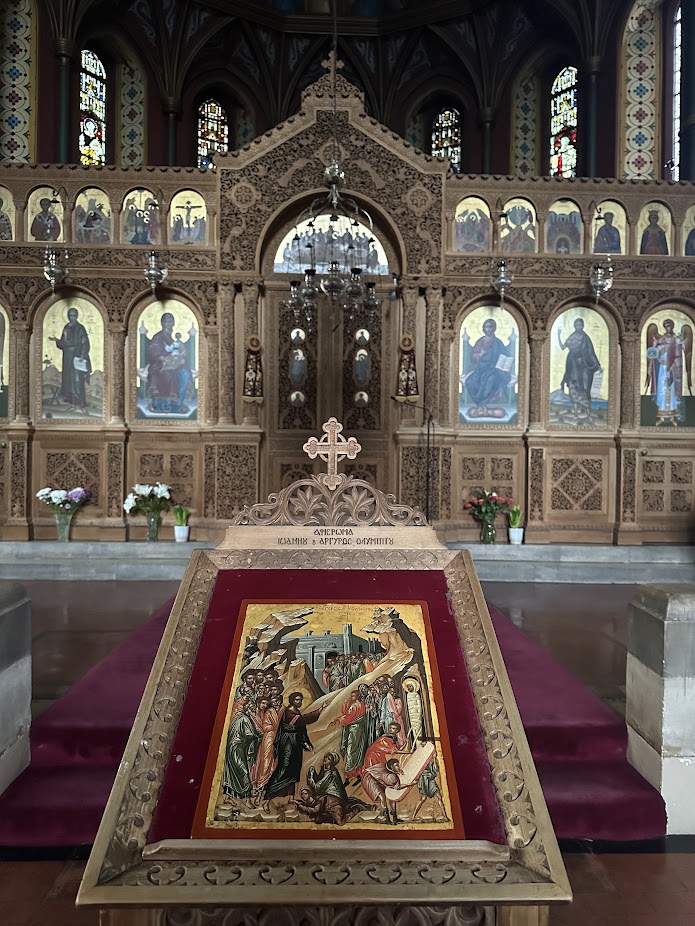
Today brothers and sisters in Christ, the Church commemorates the raising of Lazarus which occured the week before our Lord’s Passion. Today marks the end of the period of Great Lent and the beginning of of Holy Week. This miracle stands as both a revelation and a prophecy. It is not simply an act of power, nor merely an act of compassion, but a decisive manifestation of who Christ is, and what He has come to accomplish for the salvation of the world. This event is, as the Fathers tell us, a prelude to the Passion and a confirmation of the Resurrection. Before Christ freely goes to His voluntary suffering, He reveals Himself unmistakably as the Lord of life and death. First, we must contemplate the profound mystery of Christ’s tears. The Gospel tells us simply: “Jesus wept.”
Here we encounter the great mystery of the Incarnation. The One who stands before the tomb is not merely a man, nor merely God, but the God-Man—perfect in divinity and perfect in humanity. In His divine nature, He knows that He will raise Lazarus; by virtue of His human nature, He truly experiences sorrow. However the divine and human natures are united in the Person of Jesus Christ. So just as it is fitting for us to say “Mary is the Mother of God,” it is also right and fitting to say “God Himself wept.” This is not a superficial or symbolic weeping. It is real. It is existential. It is salvific. So why does Christ weep? He weeps out of love—for Lazarus, for his sisters, for all humanity. But more deeply, He weeps at the reality of death itself. Death is not natural to humanity. In other words it is not part of the original goodness of creation. It is an intruder—a consequence of sin, of humanity’s rupture from communion with God, who alone is Life by nature. As the Fathers teach, death is not simply biological cessation; it is the manifestation of separation from God. And thus, standing before the tomb, Christ confronts the full tragedy of the fallen world. Yet His tears are not despairing. They are not the tears of one defeated, but of One who is about to conquer. This leads us to His declaration to Martha: “I am the Resurrection and the Life. He who believes in Me, though he die, yet shall he live.”
Notice that Christ does not say, “I will give resurrection,” but “I am the Resurrection.” Resurrection is not merely an event—it is a Person. Life is not merely a condition—it is communion with Him. Thus, the raising of Lazarus is not only a miracle; it is a revelation of Christ’s very identity as the Source and Ground of life itself. Secondly, we must consider the deliberate delay of Christ. When He hears that Lazarus is ill, He does not go immediately. Instead, He waits four days.
This delay is deeply theological.
There existed a belief among the Jews, a Rabbinic opinion, that the soul remained near the body for three days after death. By the fourth day, corruption had fully set in, and all possibility of return was gone. Christ waits precisely until this moment—when death is no longer ambiguous, when hope has entirely vanished according to human understanding. Why?
So that the miracle may be revealed in its full clarity, and so that no one could reduce it to illusion, coincidence, or misunderstanding. Lazarus is not revived—he is raised. And this raising is an unmistakable testimony to Christ’s divine authority.
But more than this: Christ reveals that His power is not limited by time, decay, or human expectation. He is Lord over life and death. And then comes the divine command: “Lazarus, come forth!”
The voice that once called creation into being—“Let there be light”—now calls a dead man out of the tomb. And Lazarus obeys. Death itself obeys. Corruption yields. The tomb becomes a place of revelation rather than finality. Yet Lazarus emerges still bound—his hands and feet wrapped in grave clothes, his face covered.
This detail is not incidental; it is deeply symbolic. Lazarus is truly raised, but he is raised back into this fallen, temporal life. He remains subject to mortality. He will die again. He still lies today awaiting the general resurrection from the dead in Cyprus. His resurrection is a restoration, not yet a transformation.
Contrast this, with Christ’s own Resurrection. When Christ rises, the grave clothes are left behind, neatly folded. Christ is not merely returned to life—He inaugurates a new mode of existence. His Resurrection is not a reversal of death, but its complete and final overthrow. In Lazarus, we see a sign. In Christ, we see the fulfillment. It is a promise that death is not ultimate—that it has been entered into, confronted, and will be destroyed by Christ. But it is also a provocation to faith.
Christ says to Martha: “Do you believe this?” And this question is directed to each of us. Do we truly believe that Christ is the Resurrection and the Life? Do we live as though death has been conquered?
Or do we remain, like Lazarus, bound in the grave clothes of fear, sin, and spiritual inertia? Because there is also a spiritual interpretation of this Gospel.
Each of us, in our sin, experiences a kind of death. The soul becomes entombed—sealed by habits, by passions, by forgetfulness of God.
And yet Christ stands before the tomb of our heart and calls us by name.
But even when we respond, we may still be bound. And so Christ commands the community of the Church: “Loose him, and let him go.”
Here we see the life of the Church—the sacramental life, confession, prayer, ascetic struggle—as the means by which we are gradually unbound and restored to true life. And now, as we stand on this sacred day, we are poised at the entrance of Holy Week. The One who raises Lazarus will tomorrow enter Jerusalem, fulfilling the prophecy of the Prophet Zechariah:
“Behold, your King comes to you… humble, and riding on a donkey.”
He enters not as a worldly conqueror, but as the suffering Servant. The One who calls Lazarus from the tomb will Himself enter into the tomb. But this is no contradiction. It is the very means of victory. For by His voluntary death, Christ tramples down death. By entering into its depths, He shatters its power from within.
Lazarus Saturday therefore gives us the key to understanding Pascha: death is defeated not by avoidance, but by transformation. Let us, then, enter this coming week with reverence, with repentance, and with faith and especially hope. Let us hear the voice of Christ calling us out of our own tombs.Let us allow Him to unbind us. And let us follow Him—from Bethany to Jerusalem, from the Cross to the empty tomb, from death to life everlasting. Amen.
Deacon Ambrose Theodorou