


Sermon on Holy Communion – 8/4/26
Holy Thursday
2026
Sermon On Holy Communion
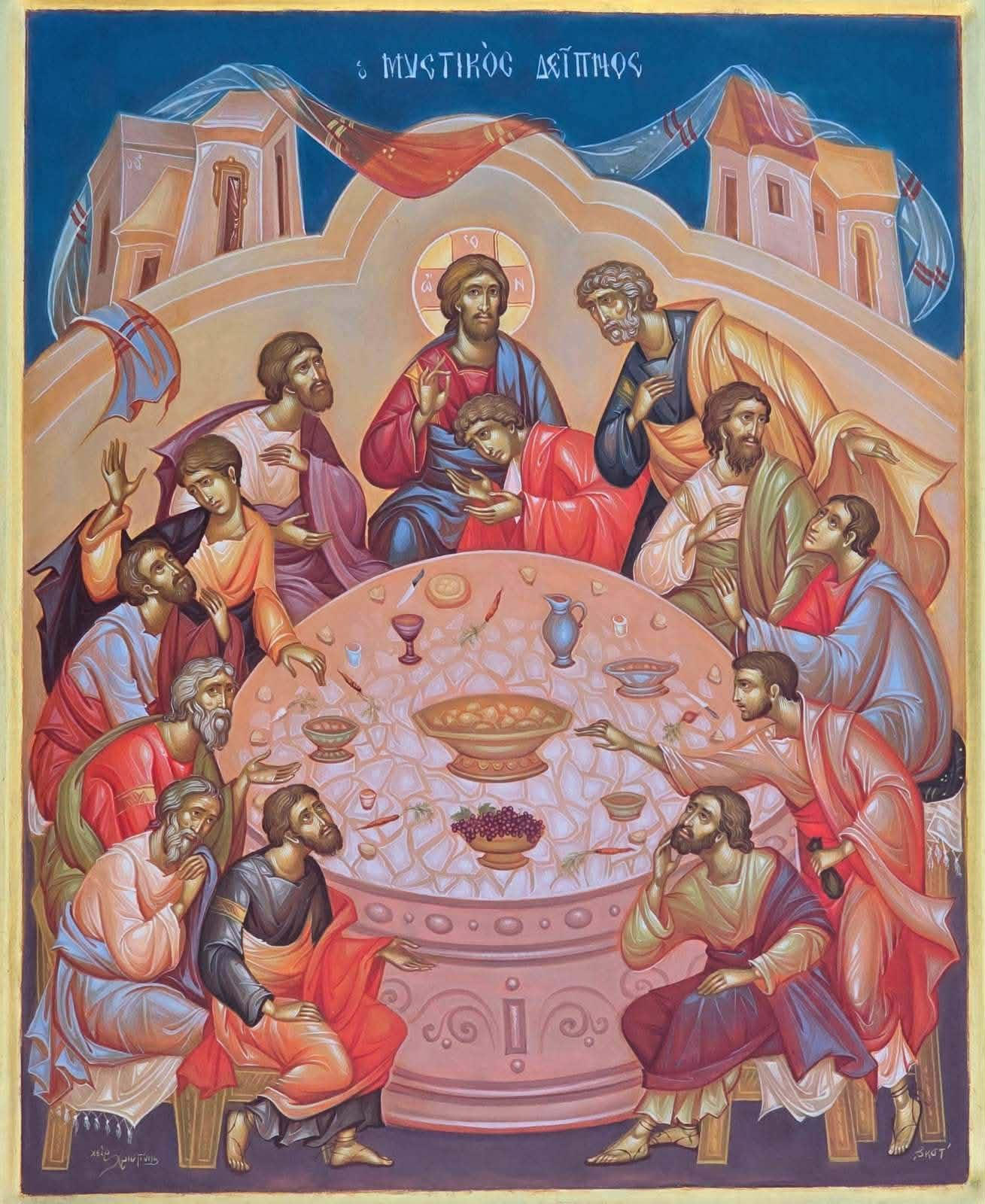
On Holy Thursday, as we will shortly hear in the prayers of the Divine Liturgy, our Lord, God and Saviour Jesus Christ left unto us for a remembrance of his saving passion the things which we are about to here set forth according to his commandments. When he was about to go forth to his voluntary and ever-memorable and life-giving death, in the night that he gave himself for the life of the world, he took bread in his sacred and most pure hands and shewing it unto the God and Father, when he had given thanks, and blessed and hallowed it, he brake it and gave it to his holy disciples and apostles, saying: Take, eat; this is my body which is broken for you for the remission of sins. Likewise he took the cup with the fruit of the vine, and when he had mingled it, had given thanks, blessed and hallowed it, he gave it to his holy disciples and apostles saying: Drink ye all of it; This is my blood of the new testament, which is shed for you and for many for the remission of sins. Do this in remembrance of me: for as often as ye eat this bread, and drink this cup, ye do shew my death and confess my resurrection. Wherefore we also, having in remembrance his redeeming passion and life-giving cross, the three days he was in the tomb, his resurrection from the dead, his ascension into heaven and his sitting on the right hand of the God and Father, and his glorious and dread coming again, offer him his own of his own, in all and for all.
But, even when we confess that the bread is “in very truth the precious body of our Lord and God and Saviour Jesus Christ” and that the cup is “in very truth the precious blood of our Lord and God and Saviour Jesus Christ”, we must be careful not to think that the Mystery of the Eucharist is simply a reenactment or continuation of the Lord’s Supper.
The Eucharist does not only take us back to the Upper Room in Jerusalem two thousand years ago; it is “fellowship of the Mystery which from the beginning of the world hath been hid in God” (Eph. 3:9), it is “the kingdom prepared for you from the foundation of the world” (Matt. 25:34). The Eucharist is what defines our existence as human beings, and our relationship to God and to the world.
As a Communion of three coequal and co-eternal divine Persons, “God is love” (1 John 4:8). To love means to give, which is why, at the moment of creation, these three Persons say “Let us make man in our image and according to our likeness” (Gen. 1:26), giving us the potential, if freely chosen, to become by grace all that the Holy Trinity is by nature, to become, as the Apostle Peter says, “partakers of the divine nature” (2 Peter 1:4).
In order for us to become partakers of his divine life, God gives himself to us by making himself a partaker of our humanity. “For God so loved the world that he gave his only-begotten Son, that whosoever believeth in him should not perish, but have everlasting life” (John 3:16). And this everlasting life does not come to us simply by moral justification or by theological abstraction, but real and even physical participation. When the Word of God, by whom all things were made, “became flesh and tabernacled among us” (John 1:14), he is born for us in the town of Bethlehem, ‘The House of Bread’, and is laid in a manger, a feeding trough, in order to show us that God gives himself to us as our “daily bread”. “The Word became flesh”, and it is by partaking in this flesh that we are joined to the reality of God’s Incarnation. “For my flesh”, he says, “is food indeed, and my blood is drink indeed. He that eateth my flesh, and drinketh my blood, dwelleth in me, and I in him” (John 6:55-56). On the other hand, “If you do not eat the flesh of the Son of Man and drink his blood, you will not have life in yourselves” (v. 53).
When the Lord appeared to the disciples on the road to Emmaus after his resurrection, “their eyes were holden that they should not know him” (Luke 24:16). It was only after he broke the bread that “their eyes were opened, and they knew him…in the breaking of the bread” (v.31,35). Before the Lord ascends bodily on the 40th day, he says “I will not leave you as orphans: I will come to you…the world seeth me no more; but ye see me: because I live, ye shall live also…the Comforter, the Holy Spirit, whom the Father will send in my name, he shall teach you all things, and bring all things to your remembrance” (John 14:18-19, 26). The world no longer sees the Lord, but we in the Church, who have received the Holy Spirit, see him in the breaking of the bread, when the Holy Spirit descends upon the gifts that we offer up on the altar “In remembrance of our Lord, God and Saviour Jesus Christ”.
On the icons on either side of the Beautiful Gate, we see the past coming of the Lord in humility as a babe, and his future coming in glory. But during the Divine Liturgy, we see him on the Holy Table, present with us now, every bit as concretely as in his former coming. As we prayed last night at the service of Holy Unction, God calls us, his “humble and sinful and unworthy servants, entangled in many sins and rolling in the passions of pleasure [to look] within the veil, into the Holy of Holies, where the holy Angels desire to look…and behold with [our] own eyes the face of the holy Oblation, and to partake of the divine and sacred [Communion] (cf. 5th Prayer).
Even the Angels, who encircle the throne of God chanting the thrice-holy hymn, are not granted the kind of union with God that is available to us in the Divine Liturgy. For the Word of God did not become an angel, but became man like us in all things but sin, since man alone is made lord of creation, being the only creature that belongs to both the seen and unseen spheres of creation, and therefore the only creature able to unify creation and act as its point of reference, which is why man uniquely is given dominion over all things (Gen. 1:26) and why he is the one tasked with naming the other creatures (Gen. 2:29), thereby bestowing upon them their identity.
Creation refers to us, and we refer to God; and we do so specifically through Jesus Christ and in the Holy Spirit. As our Lord says, “I am the way, the truth and the life. No one comes to the Father except through me” (John 14:6), for “No man hath seen God at any time; the only begotten Son, which is in the bosom of the Father, he hath declared him” (John 1:18). And when the Lord says this, he refers explicitly to the Eucharist. “No man hath seen the Father, save he which is of God, he hath seen the Father. Verily, verily, I say unto you, He that believeth on me hath everlasting life [and] I am that Bread of Life” (John 6:46-48).
Holy Communion is not only what makes us Christians and members of the Church, it is what makes us human, it is what gives us access to God and to the participation in divine life for which we were created. And by “unit[ing] us all one with another, as many as are partakers of the one bread and cup in the communion of the one Holy Spirit”, Holy Communion also restores to us the image of the Trinitarian God in which we were created.
When St Paul warns us against unworthy participation in the Eucharist in today’s Epistle reading, he defines this specifically as “not discerning the Lord’s body” (1 Cor. 11:29). This means both a failure to recognise the Eucharist for what it is — a physical encounter with Christ himself — and a failure to recognise the people who make up the Body of Christ, turning the Eucharist into a private devotion, a simple blessing, rather than the “union of all” (cf. the Great Litany) in Christ.
The latter recognition requires reconciliation, forgiveness, and acts of charity, mercy and love. The former recognition requires that we prepare ourselves through prayer, fasting, through the Sacrament of Confession; that we “turn away from evil, and do good; seek peace, and pursue it” (Psalm 33:18). In the Gospel reading we just heard, the Lord asks his disciples, “could ye not watch with me one hour?” (Matt. 26:40). Can we really presume to come prepared if we have not watched with the Lord for at least an hour at the Liturgy before we receive His Body and Blood? And not simply be present — the disciples were also present, but asleep — but to watch; to stand well, to stand with fear and attend to the Holy Oblation, actively and prayerfully participating in all that is taking place.
When we approach the Holy Chalice, we are receiving “Our God [who] is a consuming fire” (Heb. 12:29), which is why the spoon used to administer the Mysteries is not called a spoon but a tong (lavida), reminding us of the angel that touched the burning coal to the lips of the prophet Isaiah when he saw the Lord enthroned in his temple (Isaiah 6). If we come with the fear of God, with faith and love, the divine fire will refine us, enlighten us, and purify us, and be for us a foretaste of the light of paradise. But if we come without preparation, without faith and without love, it will be unto our condemnation and a foretaste of the unquenchable fires of Gehenna.
Not that anyone should be discouraged from approaching — the Master of the house has lovingly invited us, and we must by no means turn down his invitation (cf. Luke 14) — but we should understand what we are approaching.
Holy Communion is not just a blessing for life to go well, not a talisman to ward off bad luck, not a reward for good behaviour when we periodically decide to give religion a try, it is not a nice add-on to life; it is an encounter with the living God and the reason we exist.
“Come; for all things are now ready” (Luke 14:17)
Fr Kristian Akselberg