


Sermon on Forgiveness Sunday – 22/2/26
Sermon for the Vespers of Forgiveness
Tonight we enter into the most austere and solemn period of the Ecclesiastical year: the season of Great Lent. Lent is a time of intensified spiritual struggle. We fast strictly, we pray more earnestly, we attend longer and more frequent Church services. Yet the Lenten season presents us with something before all of this: the rite of Forgivness.
In a few moments we will all bow before eachother and ask for forgiveness from one another with words such as “forgive me a sinner.” The origin of this rite comes from the monastics of Egypt and Palestine who had the tradition of leaving the monastery at the beginning of Great Lent and withdrawing into the wilderness for 40 days to engage in deeper prayer and ascetism in solitude. Many of them never returned to the monastery for Palm Sunday having died in the wilderness. This practice of asking sincerely for forgiveness from their brethren at the beginning of Lent was not merely a emotional or sentimental practice for these ascetics. It was existential and eschatological. Remember the words of our Lord in this mornings Gospel, “if you forgive men their trespasses, your heavenly Father will also forgive you. But if you do not forgive men their trespasses, neither will your Father forgive your trespasses” Matt 6:14-15.
The same concern and urgency should apply to us regardless of the fact that we shall unfortunately have to remain here in the cities. Who is to guarantee that we shall live to reach the glorious feast of Pascha? If we were to depart this life would we not wish to be reconciled with one another? After all, love for God and love for our neighbour cannot be seperated, as the Apostle John teaches, “If someone says, “I love God,” and hates his brother, he is a liar” 1 Jn 4:20.
But why is this extreme, self abasing level of forgiveness a prerequisite to our Lenten ascesis? Because completely selfless, sacrificial love is the foundation of Christian life. We long for communion with a God who IS love cf. 1 Jn 4:16. Salvation is to become by grace what God is by nature. Saint Symeon the New Theologian said, “it is not what man does which counts in Eternal Life, but what he is; whether he is like Jesus Christ our Lord, or if he is different and unlike Him.” This puts the Christian commandment of love into perspective. “As the divine Chrysostom says, “nothing makes us so like God as being ready to forgive.” Think about that. Not miracles. Not knowledge. Not ascetic feats. Forgiveness makes us like God, because God forgives. God loves. Every time we forgive, everytime we love, we participate in His own life. Without love our acts of ascetism are reduced to a pharisaic mode of behaviour without any value in eternity.
Consider the words of the Holy Apostle Paul in the 13th chapter of his 1st Epistle to the Corinthians: “Though I speak with the tongues of men and of angels, but have not love, I have become sounding brass or a clanging cymbal. And though I have the gift of prophecy, and understand all mysteries and all knowledge, and though I have all faith, so that I could remove mountains, but have not love, I am nothing. And though I bestow all my goods to feed the poor, and though I give my body to be burned, but have not love, it profits me nothing” 1 Cor 13:1-3. Here Saint Paul says that even if we possess great virtues and the power to work miracles but have not love, we actually possess nothing.
To drive the point home, I want to hone in on the last part. “…though I give my body to be burned, but have not love, it profits me nothing.” Giving the body to be burned is an image of martyrdom. Martyrdom is the greatest of all works according to the Fathers. To suffer and shed one’s blood for Christ. Ascetic and monastic life is often referred to as a “white martyrdom” for it is a continual dying to the self for Christ. Saint Paul is saying that even martyrdom is useless without love. Saint Nicodemus the Hagiorite elaborates on this in a truly fearful and terrifying way. He writes to monks on Mount Athos, “if you do not uproot the hatred from your heart and do not plant love…know that, (and forgive us for such boldness), you reside in the mountains and hills in vain. All of your ascetic labours and struggles and sweat are in vain. Shall we say something greater? If you endure physical martyrdom for Christ, but have hatred and do not love your brethren, your martyrdom is in vain.”
This should shake us to our core. We could labour all our lives in fasting, vigils and long Church services, yet by not drawing out and expelling the hatred and resentment from our hearts and implanting divine love for our brethren we could lose our salvation. Love itself can even save us! There are stories in the Sayings of the desert Fathers of monks who lived their lives being very negligent of their ascetic duties. Yet when death came and the demons came to claim their souls they were saved at the last moment because of their lifelong loving and forgiving disposition.
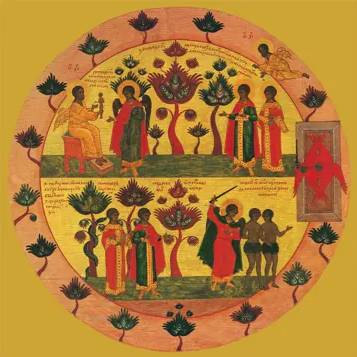
A short word on fasting. Tommorow the Great Fast begins. Saint Basil the Great calls fasting, “the medicine of the soul.” Medicine is not always pleasant. But its goal is to heal us. We don’t fast because food is evil. All of God’s creation is “good” cf. Gen 1. We fast because our desires are disordered. In the beginning, our ancestors Adam and Eve, and through them the whole of humanity fell from grace through the misuse of food – not because food is bad, but because obedience was broken. Fasting retrains our desire. It teaches the soul that it is not a slave to appetite. It can be rightly said that the ancestral sin was a breaking of the God given fast. So let us remember that we fast first and foremost in obedience to Christ’s Church. And God only gives to us what is beneficial to our souls.
Some say “but I become weak during fasting.” Good! Let your bodily weakness spur you on to find your strength and sustenance in the Sustainer of our souls and bodies. Our Saviour Himself rebuked the Devil with the words, “for man shall not live by bread alone, but by every word that proceeds from the mouth of God” Deut 8:3, Matt 4:4.
I shall conclude by sharing with you all a great story of saintly courage regarding the keeping of the Lenten fast narrated by Saint Theodore the Studite (759-826) on the third Sunday of Great Lent. Fourteen Bulgarian Christians were ordered by a pagan ruler to eat meat during the Great Fast in violation of the Christian rule as a denial of their faith. Refusing, they chose martyrdom instead. Even after one was killed and his family enslaved to intimidate the others, they remained steadfast, declaring their loyalty to Christ. They were ultimately crucified giving their lives for the love of Christ and His commandments. Let us keep such examples before us in our struggle.
Remember that fasting is a means to an end. Not an end in itself. Let us fast with humility. Not like the Pharisee who boasted that he fasted twice a week. But turn to God with the humility and repentance of the Publican saying “God be merciful to me a sinner” Lk 18. The foundation of what we do in Lent is established here tonight. So let us forgive and love one another from the depths of our hearts so as to have communion with God and one another. May we all have a blessed and fruitful Lenten struggle and a good repentance! And forgive me a sinner!
Deacon Ambrose Theodorou