


Please note that this is not a rule book or a list of absolutes, but guidelines and suggestions based on frequently asked questions. The purpose of the below text is to make your visit more comfortable, not to burden you. Please come as you are, and don’t worry about getting things wrong.
If you have any relevant questions not covered below, please email them to us and we’ll add it to the list.
When can I visit?
Anyone and everyone is welcome to visit at any point during opening hours. Only direct participation in the Sacraments is limited only to baptised members of the Orthodox Church.
Can I take pictures?
You may take pictures in the church when there is no service going on. During services, please refrain from photography or filming without prior permission, for reasons both of reverence and the privacy of others in attendance.
The Sign of the Cross
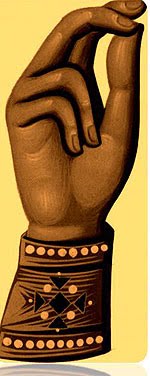 Orthodox Christians make the sign of the Cross by joining the thumb, index finger and middle finger of their right hand (symbolising the Holy Trinity) and pushing the ring finger and little finger down to the palm of the same hand (symbolising the two natures of Christ — divine and human — and His coming down to earth in the Incarnation).
We then touch our forehead, our belly, our right shoulder and our left shoulder, often concluding with a small bow.
Dress Code
We gather in church to worship, and we should take care not to distract others from that task. For this reason, clothing worn in church should be modest. We should avoid clothing that is extravagant, overly revealing, or which features loud or provocative text or images.
Chest and shoulders should be covered, arms should be covered down to the elbow, men should wear long trousers (no shorts) and women’s dresses or skirts should be below the knee.
Following the teaching of the Apostle Paul in his 1st Epistle to the Corinthians (11:4-5), the Tradition of the Christian Church from the beginning has been for lay-men to uncover and for women to cover their heads during worship. This, however, is entirely a matter of personal choice.
Entering the Church
As we enter the church, we make the sign of the Cross. If you are alone, you may wish to make three bows (we make the sign of the Cross, then bow from the waist, touching our right hand to the floor as a reminder that we were taken from the dust), while saying: “In the multitude of Thy mercy shall I go into Thy house; I shall worship toward Thy holy temple in fear of Thee” (Psalm 5:7). If a service is in progress or there are others entering the church at the same time, it is more appropriate to simply make the sign of the Cross without bows or any other outward signs of piety.
Once inside, it is customary to light one or several candles. The candle reminds us of the light of Christ. As the candle is consumed in order to produce light, it also reminds us that Christian life is one where we sacrifice ourselves in order to convey that light of Christ to others. As we light our candle and place it in the sand, we make the Sign of the Cross and silently say a short prayer for ourselves and/or our living and departed loved ones.
After lighting our candle, we venerate the icons on the stands at the back of the church. We do this by making the sign of the Cross and then kissing the icon. Again, when alone, making three bows before we kiss the icon is customary, but if a service is in progress, it is better to avoid what might distract or get in the way of others.
Ideally, we venerate icons in the following way: Our Lord Jesus Christ, the Most Holy Theotokos, St John the Baptist, the patron saint of the Church, the saint of the day. But in practice, it is best to venerate them in the order that will cause the least amount of commotion.
When a service is in progress, please do not come up to venerate the icons on the Templon (icon screen) at the front of the church.
Sitting and standing
The default posture of prayer in the Orthodox Church is standing, and many Orthodox churches have either no or limited seating. After all, we attend church as active participants, not as spectators.
The rows of seats we have at St Andrew’s are called stasidia, or stalls; in other words, places you stand. The stalls feature a fold-down seat to be used only when needed.
As a general rule, we sit only when we are being instructed: during the long readings from the Psalter (called kathismata, or sessions, for this reason), readings from the Old Testament, the Book of Acts or the Epistles, readings from the lives of the saint, and during the sermon. The rest of the time, we stand.
Of course, this does not apply to the elderly, infirm, pregnant, etc. It has also been said, “better to sit and focus on God than to stand and focus on the pain in your feet”. Everyone has different levels of endurance. If you feel like you need to sit down: sit down. No one will mind (unless you sit with your legs crossed, in which case one of the older ladies might lovingly correct you!).
That being said, there are certain moments when we should try our best to stand unless prevented by ill health:
Vespers
- During the reading of the opening Psalm 103 and the Litany of Peace.
- During the censing of the church when ‘Lord, I have cried’ is sung.
- During the entrance with the censer or Gospel.
- During the Litany of Fervent Supplication (‘Let us all say’), the prayer ‘Vouchsafe, O Lord’, the Litany of Completion (‘Let us complete our prayer’) and the prayer of bowed heads.
- From the Song of Symeon (Now lettest Thou Thy servant…) up until the end of the service.
Matins / Orthros
- During the opening prayers, the reading of the Six Psalms, and the Litany of Peace.
- During the reading of the Holy Gospel, if there is one. On Sundays, also during the veneration of the Gospel Book.
- During the censing of the church during the chanting of the 9th Ode.
- During the chanting of the Great Doxology.
The Divine Liturgy
- During the opening benediction “Blessed is the Kingdom” and the Litany of Peace.
- During the Entrance with the Holy Gospel
- During the singing of the Trisagion (‘Holy God, Holy Mighty, Holy Immortal, have mercy on us’).
- During the reading of the Holy Gospel
- During the Cherubic Hymn and Entrance with the Holy Gifts
- During the reading of the Creed
- During the whole Anaphora (from the exclamation ‘Let us stand with awe’ until the benediction ‘And the mercies of our great God and Saviour Jesus Christ’).
- During the Our Father and the two prayers which follow it (until the exclamation ‘The Holy Things for the holy’ and the Choir’s response, ‘One is holy, one is Lord…’).
- During the Communion of the People
- During the Prayer behind the Ambon (‘O Lord, Thou dost bless those who bless Thee’) and the final dismissal.
Kneeling
We follow the tradition of the ancient Church that forbids “prayer on bended knees” on Sundays; we instead stand in honour of the Resurrection.
During weekday Liturgies, we are encouraged to kneel during the Consecration of the Holy Gifts. After the priest has exclaimed the Words of Institution (‘Take eat’, ‘Drink of this’), we kneel as he lifts the Holy Gifts saying, ‘Offering Thee Thine own of Thine own’. We stay on our knees until he again exclaims, ‘Above all for our all-holy…’ and the choir begin to sing the Axion Estin hymn to the Mother of God.
During Vespers and Matins, people may kneel during any of the moments where sitting or standing aren’t specifically appointed.
Antidoron
At the end of the Divine Liturgy, blessed bread called antidoron (literally, “instead of the Gifts”) are distributed to those who for whatever reason were unable to partake of Holy Communion. In the UK, it is common practice to allow also non-Orthodox Christians to receive antidoron. Please be aware that both antiodoron and holy water, like Holy Communion, should be taken on an empty stomach. If you ate before coming to Church, it is better to refrain.